
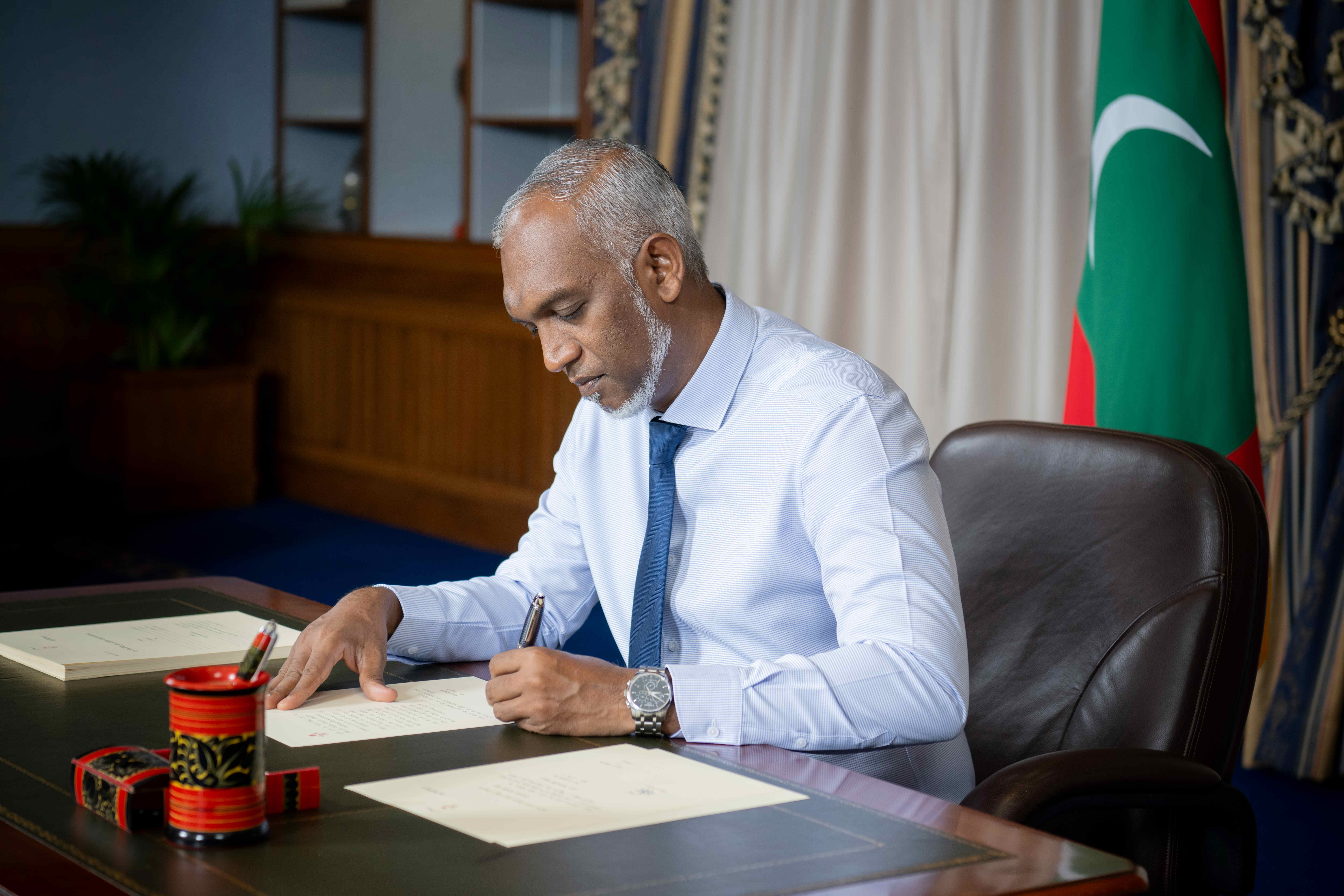
President Dr. Mohamed Muizzu has ratified three major legislative changes that reshape the Maldives’ decentralized governance system, including the abolition of atoll councils and new frameworks for council elections.
The Seventh Amendment to the Constitution, passed by the 20th People’s Majlis on 25 November, abolishes atoll councils under the decentralized administrative structure. The dissolution will take effect with the next local council elections, while current atoll councils will continue until newly elected bodies take office.
Separately, the President ratified the 17th Amendment to the Decentralization Act, passed on 27 November. The amendment confirms that each inhabited island—excluding city councils—will be governed solely by its island council, which will report to the Local Government Authority. Councils on islands with fewer than 2,000 residents will have three councillors, including one woman, while islands with larger populations will have five councillors, including two women.
The amendment also revises the composition of Malé and Fuvahmulah city councils, introduces a structured allocation of women’s seats across all cities, and establishes the Women’s Development Committee Chairperson as a full-time elected role. It further outlines conditions under which councillors must vacate office, including switching political parties or resigning from the party under which they were elected.
In addition, President Muizzu ratified the Eighth Amendment to the Local Council Elections Act, which sets clearer procedures for city and island council elections and mandates that by-elections to fill council vacancies be held twice a year.
All three amendments have now come into force following their publication in the Government Gazette.
The Seventh Amendment to the Constitution, passed by the 20th People’s Majlis on 25 November, abolishes atoll councils under the decentralized administrative structure. The dissolution will take effect with the next local council elections, while current atoll councils will continue until newly elected bodies take office.
Separately, the President ratified the 17th Amendment to the Decentralization Act, passed on 27 November. The amendment confirms that each inhabited island—excluding city councils—will be governed solely by its island council, which will report to the Local Government Authority. Councils on islands with fewer than 2,000 residents will have three councillors, including one woman, while islands with larger populations will have five councillors, including two women.
The amendment also revises the composition of Malé and Fuvahmulah city councils, introduces a structured allocation of women’s seats across all cities, and establishes the Women’s Development Committee Chairperson as a full-time elected role. It further outlines conditions under which councillors must vacate office, including switching political parties or resigning from the party under which they were elected.
In addition, President Muizzu ratified the Eighth Amendment to the Local Council Elections Act, which sets clearer procedures for city and island council elections and mandates that by-elections to fill council vacancies be held twice a year.
All three amendments have now come into force following their publication in the Government Gazette.